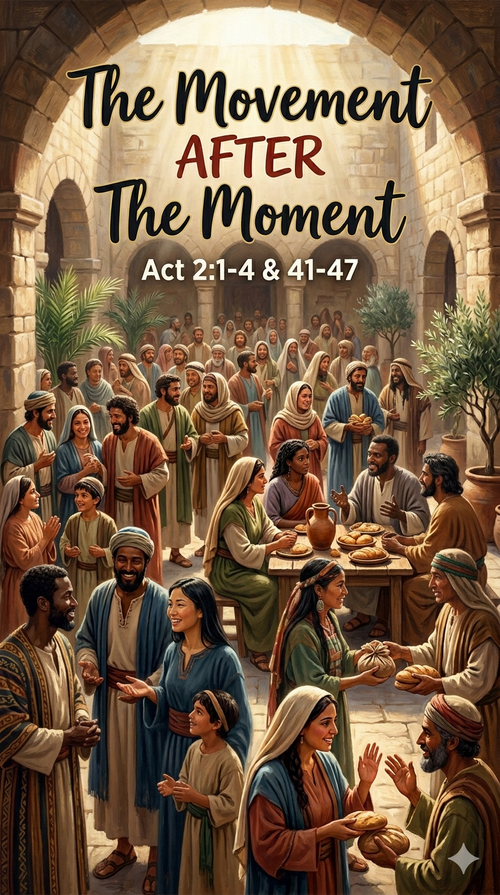
The sermon is a fifth Sunday worship service and sermon delivered by Bishop Tyson. The session transitions from communal prayer and testimony into a deep theological exploration of the "Movement after the Moment," focusing on the sustaining power of the Holy Ghost beyond the initial experience of Pentecost.
Executive Brief
Bishop Tyson delivers a thesis on spiritual consistency, arguing that the "moment" of Pentecost (the initial filling of the Holy Spirit) is secondary to the "movement" (the subsequent lifestyle and doctrine). He emphasizes that the New Testament church was defined not by emotional outbursts, but by steadfastness in teaching, fellowship, and communal care. The sermon serves as a call to transition from "firework" spirituality—flashy but temporary—to a "fireplace" lifestyle that provides consistent warmth and utility.
Key Insights & Theological Thesis
Executive Brief
Bishop Tyson delivers a thesis on spiritual consistency, arguing that the "moment" of Pentecost (the initial filling of the Holy Spirit) is secondary to the "movement" (the subsequent lifestyle and doctrine). He emphasizes that the New Testament church was defined not by emotional outbursts, but by steadfastness in teaching, fellowship, and communal care. The sermon serves as a call to transition from "firework" spirituality—flashy but temporary—to a "fireplace" lifestyle that provides consistent warmth and utility.
Key Insights & Theological Thesis
- The "Fully Come" Distinction: Bishop Tyson analyzes the phrase "when the day of Pentecost was fully come" (Acts 2:1). He posits that while the Spirit appeared in limited capacities in the Old Testament (e.g., David), Pentecost marked the transition to a universal, permanent indwelling available to all, characterized by unity and "one accord."
- Posture of Reception: A significant portion of the discourse challenges cultural assumptions about the Holy Spirit. Bishop Tyson notes that the disciples were "sitting" when the Spirit fell, suggesting that spiritual empowerment does not require physical "falling out" or performative movement, but rather a correct internal atmosphere.
- Vision vs. Dreams: Addressing church leadership, the Bishop advocates for empowering younger generations. He distinguishes between "dreams" (often associated with the elderly/slumber) and "visions" (associated with the young/active movement). He warns that failing to elevate young leaders effectively "kills the vision" of the church.
- The "Fireplace" Metaphor: He contrasts fireworks with a fireplace. Fireworks are momentary, loud, and purely for show. A fireplace requires consistent fuel (the Word and prayer) and provides lasting value. He urges the congregation to move away from event-based faith toward a sustainable spiritual lifestyle.
- Institutional Self-Reflection: Bishop Tyson concludes with a candid moment of self-critique. He questions why, despite following the "New Testament prescription" for a church, growth may stall. He encourages leaders to perform "self-surveys" rather than assuming everything is spiritually sound.
- The "Locked Door" Rationale: Using a personal anecdote about being locked out of his house, he illustrates that God often "changes the locks" on certain chapters of life. He warns against the "church folk" tendency to try and force open doors (past methods or seasons) that God has intentionally closed to move the ministry forward.
Recent
Archive
2026
May
2025
2020
December
Categories
no categories
No Comments